a-man-talking-near-a-whiteboard

The Psychology of Persuasion in Copywriting-5 Triggers That Always Work

Every great copywriter knows this truth: people don’t buy the best product.
They buy the product that makes them feel something. That’s why persuasion isn’t manipulation it’s psychology. The most powerful copy taps into how the human mind naturally reacts to emotion, risk, and reward.

Below are 5 timeless psychological triggers proven, ethical, and dangerously effective when used right. Each one has decades of behavioral research behind it and appears across the most trusted copywriting sources.

Bringing the Triggers Together

Imagine writing a sales page that uses all five triggers seamlessly:

  1. You start by giving free value (Reciprocity).
  2. You describe the emotional pain your reader feels and the hope your solution brings (Emotional Anchoring).
  3. You show proof that others succeeded using your offer (Social Proof).
  4. You create a clear but honest deadline (Scarcity).
  5. You ask for one simple next step (Commitment).

1. Reciprocity How…Give Before You Ask

This principle runs deep in human nature. When someone gives you genuine value, you feel compelled to give back.

In copywriting, this means leading with generosity. Offer a useful resource, an insight, or a valuable tip without asking for anything first. You lower the reader’s defenses, build trust, and create a sense of goodwill that naturally makes them more open to your next request.

Think of how CopyPosse and MailRelay frame it: people respond to kindness with commitment.

How to use it:

  • Share real value before your call to action.
  • Give examples, free tools, or stories that make your reader smarter or better off.
  • Then guide them toward the next step subscribing, booking, or buying.

Reciprocity works because it makes the exchange feel fair, not forced. It turns your copy from a sales pitch into a human relationship.

2. Scarcity & Urgency – When Time Creates Value

Scarcity is one of the oldest psychological levers in marketing because it never stops working.

The brain hates losing opportunities. When something feels limited, our instinct says act now or regret later. That’s why urgency drives conversions faster than logic ever could.

MailRelay’s research highlights how this trigger pushes people past hesitation. CopyPosse also stresses the “reason why” behind urgency your audience must believe the deadline or limit is real.

How to use it:

  • Set clear, authentic limits: only a few spots left, or a real deadline.
  • Tie urgency to purpose: limited capacity, not fake pressure.
  • Use natural language: “Offer closes Sunday” or “Only 50 slots remaining.”

Avoid the rookie mistake: if every campaign you run is a “limited-time offer,” people will stop believing you. Scarcity only works when it’s genuine. Done right, urgency doesn’t feel like manipulation it feels like momentum.

3. Social Proof & Authority-People Follow People

red-and-white-love-wall-decor

Humans rarely want to be first. We look for signs that others have gone before us and succeeded.

That’s why social proof remains one of the strongest persuasion tools in existence. As Jeremy Mac and CopyPosse explain, credibility, proof, and authority reduce fear and validate decisions.

When prospects see that others trust you, they trust you faster.

How to use it:

  • Add real testimonials, reviews, or success stories.
  • Show numbers or results that prove your claims.
  • Mention experience, credentials, or recognizable clients if relevant.

What matters most is specificity. Don’t write “customers love it.” Show names, details, outcomes. The sharper the proof, the stronger the persuasion. Social proof works because it bypasses skepticism. Instead of you saying “trust me,” you show evidence that others already do.

4. Emotional Anchoring & Contrast – Make Them Feel Before They Think

Logic rarely moves people. Emotion does.

This trigger is about connecting to the reader’s emotional state then guiding them toward a better one. As Medium’s article on emotional triggers explains, people buy when they feel something powerful, and only later justify it with logic. You do this through contrast: show what pain looks like, then what relief feels like. Move from frustration to hope, from loss to gain. Paint vivid before-and-after pictures.

How to use it:

  • Start your copy inside the reader’s struggle.
  • Describe the frustration, the fear, the chaos.
  • Then shift to possibility what life looks like when the problem is solved.
  • Support that feeling with facts, features, or proof.

It’s the emotional swing not the argument that sells. CopyPosse calls this the “emotion first, logic second” principle. Just don’t overplay it. If your emotion feels exaggerated or manipulative, trust breaks instantly. The goal is empathy, not melodrama.

5. Commitment & Consistency Having Small Yeses Create Big Ones

Once people take a small step, they want to stay consistent with that decision. Psychologists call this the commitment principle and it’s one of the most underrated persuasion triggers in copywriting.

CopyPosse and MailRelay both point out that consistency builds loyalty. The more your audience says small “yeses,” the easier it becomes for them to say a big one later.

That’s why smart copywriters design progressive actions: subscribe before buy, try before commit, share before upgrade.

How to use it:

  • Start with a light ask a free download, a quiz, a question.
  • Lead naturally to the next step book a call, sign up, or purchase.
  • Use momentum language: “You’ve already taken the first step…” or “Since you’re here, finish the journey.”

Each small agreement strengthens the reader’s identity as someone who acts. When the final CTA comes, it doesn’t feel like a leap just the next logical step.

The Ethics of Persuasion

That’s not manipulation. That’s empathy, structure, and psychology working together. Persuasive copy isn’t about shouting louder. It’s about understanding why people hesitate and guiding them past that hesitation with genuine clarity.

Here’s the truth; all these triggers can be abused. Scarcity can become fake. Emotion can become drama. Authority can become arrogance.

But when you write from integrity when your product truly helps and your intent is honest these psychological levers simply help the right people make faster, better decisions.

As SEOZoom and MailRelay both emphasize, persuasion should amplify truth, not distort it.

Final Thoughts

The psychology of persuasion isn’t new it’s timeless.
Reciprocity, scarcity, social proof, emotion, and consistency aren’t “marketing hacks.” They’re reflections of how human beings connect and decide.

If your copy feels robotic, it’s probably because it’s missing one of these triggers.
Inject emotion. Build proof. Create urgency. Ask for small actions. Give before you ask.

Do that, and your words won’t just inform they’ll move people.

pexels-markus-winkler-1430818-4057660

From Blank Page to Published | My Writing Process That Delivers Every Time

Every writer faces the same enemy blinking cursor on an empty page.
The difference between those who publish consistently and those who quit isn’t talent. It’s process. A strong process turns chaos into clarity. It gives you a rhythm that delivers, even on the days when inspiration doesn’t show up.

Here’s the seven-step method I use (and refine constantly) to move every piece from idea to publication reliably, efficiently, and at a professional standard.

1. Generate Ideas That Matter

Great content starts before the first word it starts with curiosity.
Look at what people are asking, struggling with, or debating. Your inbox, comment sections, and client briefs are goldmines. Writers who wait for inspiration end up chasing fog. Instead, build an idea engine. Keep a running list of questions, patterns, and moments worth expanding. Use mind maps, freewriting, or a quick voice note when something clicks. A steady supply of raw material keeps you immune to writer’s block and ensures your next idea is always one scroll away.
(inspired by Medium’s “From Blank Page to 100 Posts”)

2. Do the Research and Do It Right

Once you’ve picked your topic, dive in like a journalist.
Search broadly, not lazily look beyond the first page of Google. Read opinions that contradict each other. Note data points, quotes, and case studies that make your argument undeniable. Then, match that insight to your audience.
Ask: who’s reading this, and what tone will reach them best? A B2B founder and a Gen Z creator won’t respond to the same language or spelling conventions. Align everything tone, accent, and cultural references to your reader’s world. Good research gives you confidence. It turns content into authority.

3. Outline with Intent

An outline isn’t busywork it’s a clarity weapon. The Creative Penn calls it the divide between planners and pantsers, but here’s the truth: even discovery writers need a map. Start with a clear intro, list your main arguments, and sketch the logical flow from one section to the next. Don’t overcomplicate it. Bullet points are fine. The goal isn’t perfection it’s direction.

A structured outline keeps your writing disciplined and prevents you from wandering into tangents that dilute your core message.

When the structure is right, the words follow faster.

4. Write the Ugly First Draft

The blank page doesn’t need brilliance it needs motion. Most writers fail because they try to write and edit at the same time. That’s like driving with one foot on the brake. The goal of the first draft is not perfection it’s presence. Write fast, let the sentences be rough, and resist the urge to fix grammar or word choice mid-sentence.

Momentum beats precision at this stage. Get it out; you’ll clean it later.

5. Revise Like a Ruthless Editor

Now the real writing begins. Step away from the draft, then come back with clear eyes and a cold heart. Read it as if it’s not yours. Cut repetition. Eliminate filler. Check if every section drives the point forward. Ask yourself: “Would I read this if I wasn’t the author?”

The goal isn’t to sound smarter; it’s to sound sharper.
Most good writing happens here in the deletion, tightening, and reshaping.

6. Proof, Polish, and Localize

Once your content flows, refine it for presentation. Correct grammar, spelling, and punctuation but go deeper. Match style, tone, and accent to the client’s region. “Color” for the US, “colour” for the UK. Adjust idioms, formatting, and even examples to feel local.

This level of polish separates freelancers from professionals. Readers shouldn’t notice your editing they should simply feel how smooth the piece reads.

If possible, read it aloud. The tongue catches what the eye misses.

7. Final Review, Feedback, and Publishing

Before you hit publish, run a last-mile check.

Are your links working?

Are the subheads consistent?

Have you written a meta description that makes people click?

Then, get a second opinion. A peer or client might catch gaps or tone shifts you missed.

Once live, monitor performance engagement, comments, and feedback. Publishing isn’t the finish line; it’s the testing ground. Use data and reactions to refine your next piece.

The Cycle That Builds Momentum

Here’s what happens when you treat this process seriously

You stop writing in panic.
You start writing on purpose.
You build a rhythm that turns occasional wins into consistent output.

Every stage compounds brainstorming feeds outlining, outlining feeds drafting, drafting feeds revision. By the time you proof and publish, you’ve built a system that guarantees deliverability, not just inspiration.

Writers don’t need muses. They need mechanics that work.
And this one does.

Gemini_Generated_Image_gpcmnlgpcmnlgpcm (1)

Storytelling in Business| Turning Cold Facts Into Messages People Remember

In the age of data dashboards, bullet-point slide decks, and endless metrics, facts alone are no longer enough. Cold statistics tell what happened; stories tell why it matters and stick.

When you lead with narrative, you give facts a heartbeat. Suddenly, revenue numbers aren’t just digits; they’re victories. Customer churn isn’t a percentage; it’s a story of someone nearly walking out. Storytelling in business isn’t fluff. It’s the difference between messages people skim… and messages people carry.

Here are 7 form techniques (structure + style + delivery) to help you transform cold facts into memorable messages. Use them in speeches, presentations, reports, marketing content, leadership communications whatever needs to land.

1. Start with Conflict (or Tension) Then Show Change

Most powerful stories begin where things go wrong. The contrast between “before” and “after” is what people remember. Sources like Coaching Expatriates and One Clear Message highlight that leadership storytelling often fails when the speaker treats facts as neutral rather than as parts of a journey.

Technique:

  • Begin with a problem, crisis, or tension. For example: “Last quarter, our customer satisfaction dropped by 25% and we didn’t understand why.”
  • Show the attempted solutions (failures if any).
  • Conclude with what changed, what decisions were made, and what the new “normal” looks like.

Why it works: Conflict creates emotional stakes. You want the audience to care. Without it, facts are just background noise.

2. Use the “Normal → Disruption → New Normal” Arc

The “old normal > disruption > new normal” structure gives context, drama, and resolution. Courage & Grow emphasizes this in the storytelling frameworks they list define what things were like, show a turning point, then paint what’s changed.

Technique:

  • Normal: Paint what life/business/power looked like before (why the facts mattered then).
  • Disruption: The event or realization that changed expectations (problem, pivot, crisis).
  • New Normal: How you (or your team, or your company) moved forward, what lessons were learned, what benefits arrived.

Application: Use this in a leadership memo announcing strategy changes, or in marketing case studies. It helps audiences see progress, feel the journey, and internalize your message.

3. Make It Personal Add Human Faces, Voices, Vulnerability

Stories with names, struggles, failures, hopes these are memorable. Prezent.ai and Ed Stellar write about how the most effective business storytelling includes personal narrative or the voices of real people (customers, employees).

Technique:

  • Use real stories of people (customers, team members). Don’t generalize: name the person (if appropriate), describe what they felt, what they saw.
  • Share vulnerability: what went wrong, what was scary, what you didn’t know.
  • Use voice: dialogues, quotes, or recreations (short, authentic) rather than summary.

Why it works: Humans connect with humans. A fact about 3,000 users is forgettable and a quote from “Jane, a customer who stayed up all night frustrated by slow app performance” is vivid and sticky.

4. Use Metaphors, Analogies, and Visual Imagery

Dry facts are hard to remember. If you map them to something visual or familiar, your audience can anchor onto that. Several of your sources discuss using analogy or vivid description to bridge the gap between complex business issues and everyday understanding.

Technique:

  • Find a metaphor that matches your message: e.g. treating the company like a ship in storm, or telling that employee “data overload is like drinking from a firehose.
  • Use imagery: describe scenes, sounds, colors red alert blinking, empty inbox echoing, etc.
  • When possible, include visuals (charts, photos, video, infographics) that support the metaphor or narrative.

Why it works: Metaphors tap into memory via image, not just logic. They allow people to hold abstract ideas in mind via a concrete mental picture.

5. Anchor Facts to Outcomes & Emotions

Facts by themselves (e.g. “sales dropped 20%”) are weak. When tied to what that drop meant in real impact (job cuts, customer frustration, long nights), they hit harder. Sources especially Maurizio La Cava and One Clear Message stress that emotional relevance + clear outcome make stories land.

Technique:

  • Whenever you mention a stat, follow with the effect: what changed, what got hurt, what opportunity emerged.
  • Highlight benefits, lessons learned, transformations. E.g. not just “we cut costs by 15%,” but “we cut costs 15% so we could re-invest in product innovation, which led to a 20% increase in customer satisfaction.”
  • Link to values: tie outcomes to what people care about (trust, integrity, fairness, growth).

Why it works: Emotions plus outcomes create retention. People remember how they felt more than what they saw.

6. Keep It Compact & Structured Don’t Overload

Business storytelling works best when it’s focused. Too many details, too many side paths, and your audience loses track. StoryTagger emphasizes self-editing and Prezent.ai mentions that stories in business need clarity, not complexity.

Technique:

  • Limit scope: choose one core message or lesson per story.
  • Use a simple structure: intro, conflict, pivot, resolution.
  • Use subheads or narrative markers e.g., The Challenge, The Turning Point, What We Did, What Changed if writing; or clear transitions in speeches.

Why it works: Our brains drop threads when stories meander. Structure and focus make messages stick and make you sound confident.

7. Use Repetition, Callbacks, and Memorable Moments

To make a story stick, you need moments people will remember and you need to bring them back. Things like recurring phrases, callbacks to earlier lines, or star moments help.

Technique:

  • Introduce a powerful image, phrase, or question early in your story. Revisit it at the end or at key moments.
  • Use repetition of key ideas or motifs (e.g. “we stood at the edge,” “we decided to dive in”).
  • Create a “breakthrough moment” that people will recall (a failed pitch, an angry client, the mis-step, or the epiphany).

Why it works: Human memory likes patterns and salience. When you repeat, you reinforce. When you deliver a strong moment, people remember that more than the in-between stuff.

Applying These Techniques Quick Examples & How to Use Them

Here are a couple of mini-examples so you can see how to apply these in your own business communication

  • Leadership presentation: Start with conflict (“We lost three major clients last quarter because of product bugs”), use outcome/emotion (“Our team stayed up nights repairing damage, morale dipped, trust eroded”), then show new normal (“With revamped processes, bug resolution is now within 24h and customer retention is up 30%”). Use visuals like before/after charts, quotes from clients. End with a callback: “We were losing trust; now we are earning it every day.”
  • Marketing content: Instead of “Our analytics tool yields 50% more insights,” say “For Jane, a small business owner, our tool uncovered $10,000 in missed revenue enough to hire her first employee.” Use analogy (“like finding coins in couch cushions”), personal story, and ensure the metric feels human.

Final Word

If you want your business communications to echo not just disappear you must turn cold facts into stories people remember. Use tension. Frame change. Let vulnerability in. Paint vivid images. Anchor facts to impact. Structure tightly. Leave a star moment.

Do that, and your audience stops hearing numbers. They start hearing stories. And stories live. Facts fade.

Gemini_Generated_Image_vh1rxvh1rxvh1rxv

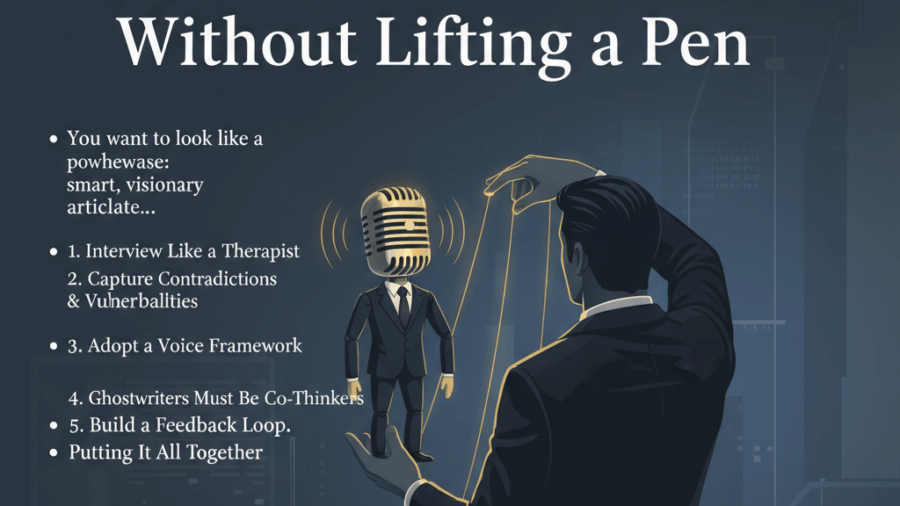
Ghostwriting Secrets: How to Sound Like a CEO Without Lifting a Pen

You want to look like a powerhouse: smart, visionary, articulate. But between board meetings, fires to put out, and travels, who’s got time to write all that? That’s where ghostwriting comes in the art of making someone else’s words feel like they came from you.

But fake it ‘till you make it doesn’t work here. If the voice is off by an inch, people notice. If the idea is shallow, critics smell it. Ghostwriting isn’t just writing; it’s ventriloquism with style, strategy, and soul

Here are 5 ghostwriting secrets that let you sound like a CEO without writing a single word yourself.

1. Interview Like a Therapist Then Transcribe Everything

A ghostwriter’s job is more excavation than invention. The best ones get to the raw bones of your thinking through deep conversations. These aren’t “yes/no” briefing calls — they’re wide open, exploratory.

Lewis Commercial Writing describes how ghostwriters begin with recorded conversations, then mine transcripts to capture voice and insight. copywriting Similarly, Nicolas Cole advises always recording the call so you can literally lift speech patterns, filler words, cadence, and idiosyncrasies.

Why it matters is that your natural voice is full of quirks the pauses, the “you know,” the metaphor you always return to. Ghostwriters who rely purely on briefs will sound like clones. Those who work from transcripts get the you in your speech.

Pro move: Do at least two 60–90 minute sessions where you talk unscripted problems, beliefs, stories. Then transcribe. Let the ghostwriter map your tone, phrases, and thought flow.

2. Capture Contradictions & Vulnerabilities

No one wants a cardboard CEO who only speaks in “Vision, Growth, Synergy.” Real leadership voice has tension. It admits uncertainty. It shows cracks. That’s what makes it human.

Ghostwriters who want to polish you into perfection fail they lose trust. As Resch Strategies puts it, one of the secrets is understand the client’s voice deeply — not just their polished public persona, but their hidden edges.

Ghostwriting isn’t about hiding your weaknesses; it’s about weaving them into your authority. You once messed up. You doubted. You pivoted. Those stories make you credible.

Pro move: Share two or three “failures” or doubts from your journey. Let your ghostwriter unearth those in your messaging. Use contrast: “I believed I had it all figured out until the numbers tanked.”

3. Adopt a Voice Framework and Guard It Fiercely

One quick way to lose your voice is to drift toward bland because editors or committees impose changes. To prevent that, establish a voice framework that becomes your ghostwriter’s North Star.

Elements include:

  • Tone keywords (e.g. blunt, visionary, electric)
  • Phrases you use (metaphors, favorite analogies, expressions)
  • Sentence length preferences (short punchy vs layered)
  • Do’s / Don’ts (e.g. no corporate clichés, no fluff intro paragraphs)

PRSA’s advice for executive ghostwriting is to revise without altering voice that means when edits land, you or the ghostwriter “hand-carry” the voice through every change.

Pro move: Write a 1-page “voice guide” for yourself. Share it with every ghostwriter or editor. Force changes to run through that filter. Voice isn’t optional.

4. Ghostwriters Must Be Co-Thinkers, Not Copy Machines

You don’t want someone who just types your ramblings verbatim. You want a partner who sharpens your thinking.

Lewis Commercial Writing says ghostwriting is part writing, part wrangling pushing clients to dig deeper, to refine ideas. A ghostwriter who echoes your buzzword without critique is worthless.

The best ghostwriters challenge your half-baked ideas, ask “why,” and force clarity. They don’t just mirror illusions, they illuminate insight.

Pro move: In your brief, ask: “Don’t just rephrase me; refine me.” Expect the ghostwriter to deliver two versions: your raw voice + a polished “you” version. Then you choose.

5. Build a Feedback Loop But Don’t Micro-Edit the Voice

Ghostwriting is iterative. After drafts drop, there should be cycles feedback, revision, tightening. But the biggest mistake executives make is micro-editing, i.e., trying to reword sentences for personal preference rather than essence.

PR pros warn: when editors alter style too heavily, the voice erodes. ClearVoice also emphasizes defining roles, expectations, and revision limits in contracts so the voice survives the process.

Instead of rewriting sentences, flag tone issues (“too formal here,” “sounds unnatural”) and ask the ghostwriter to revoice. Trust their craft.

Pro move: After each draft, read it aloud pretending it’s you. If a sentence forces you to trip over words or see a phrase you never use flag it. Don’t rewrite it; request re-voicing.

Bonus Truth: You Still Might Be Found Out

Ghostwriting isn’t magic. If done poorly, readers sense the off-rhythm, the cloned metaphors, the generic slogans. Even internal teams may spot tone drift. That’s how ghostwritten CEOs get caught.

A good ghostwriter keeps you consistent across platforms (LinkedIn, memos, blog posts). They audit past content, keep a style “memory bank,” and never let you drift too far from your established voice.

Putting It All Together

Ghostwriting for a CEO isn’t outsourcing it’s delegation with trust. You delegate the typing, but not the identity.

Here’s your takeaway

  • Start with raw, recorded conversation let your speech guide the voice.
  • Embrace contradictions; they make you human.
  • Create strict voice rules so no one dilutes your tone.
  • Demand co-thinking ghostwriters must refine, not echo.
  • Iterate smartly feedback loops, not microedits.

If you let the wrong ghostwriter take over, you risk sounding hollow or generic. But with the right one, you look powerful, authentic, and unshakably you without writing a word.

Let me know if you want me to format this with examples + templates you can drop in your next ghost project.

Gemini_Generated_Image_get4xyget4xyget4

The Difference Between SEO Writing and Copywriting and Why You Need Both

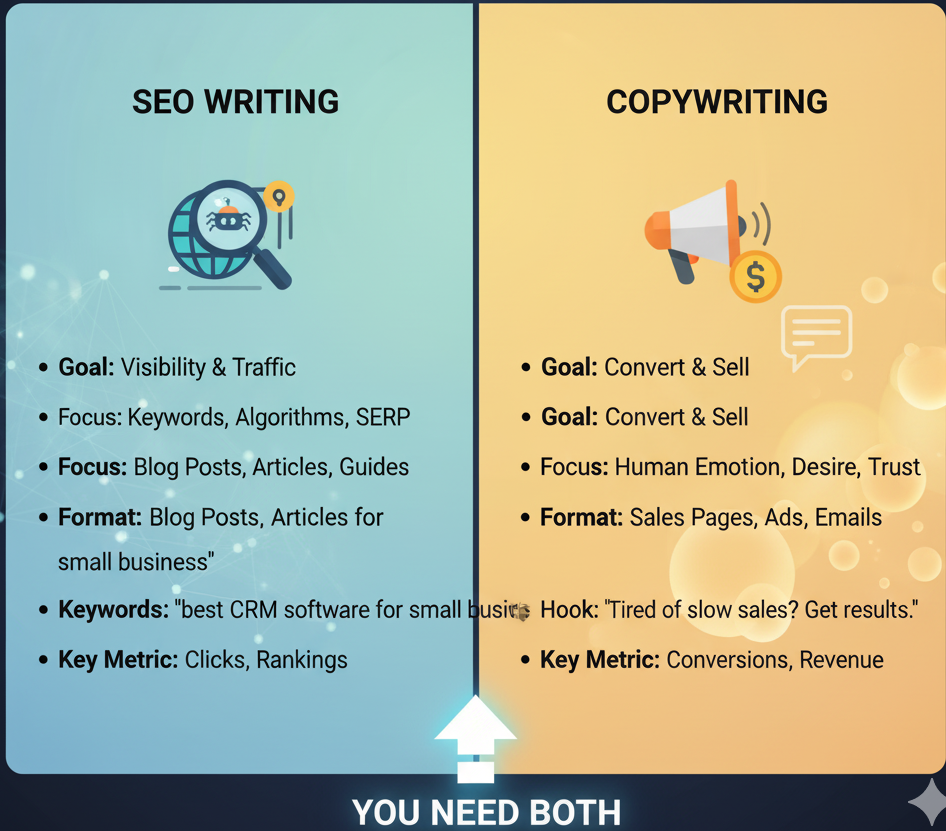
 Infographic showing the difference between SEO Writing and Copywriting

If you run a business online, you’ve probably heard this debate: “You need SEO!” vs “You need copywriting that sells!” Both camps swear they’re right. The SEO crowd says visibility is everything what good is killer copy if no one finds it? The copywriters fire back: what good is traffic if no one buys?

The truth? Both are right and both are wrong if used alone.

SEO writing drives people to your brand. Copywriting drives them through the door. Without both, your content either sits unseen on page 12 of Google or gets clicks that never turn into customers.

Yet most businesses still confuse them and it’s killing their results. Let’s break it down brutally clear. Here are 7 key differences between SEO writing and copywriting and how to combine them for unstoppable digital impact.

1. Objective: SEO Attracts, Copywriting Converts

SEO writing is about getting found. It’s tactical optimizing for keywords, structuring headers, and pleasing the algorithm gods so Google rewards you with visibility. Think blog posts, resource pages, or guides that answer what your audience is searching for.

Copywriting, on the other hand, is about getting chosen. It’s emotional, persuasive, human. It takes that attention SEO brought in and turns it into action a click, a sign-up, a purchase.

SEO writing says, “Here are the top 10 fitness apps to track your workouts.”
Copywriting says, “Stop guessing your progress use the app top trainers swear by.”

You need both. One brings traffic; the other brings money.

2. Audience Stage: Awareness vs Decision

This is where most businesses blow it. They use the wrong style for the wrong stage of the funnel.

SEO writing targets readers in the awareness or research phase people asking, “What’s the best X?” or “How to fix Y?” They’re curious, not committed. Your job is to educate, not sell. Copywriting targets the decision phase. The reader already knows what they need they just need the final nudge. That’s why copywriting rules on sales pages, emails, and ads.


Blumint’s research shows SEO content dominates early-funnel discovery, while persuasive copywriting closes at the bottom. If you try to sell hard to someone who just Googled “how to save money,” you’ll push them away. But if you serve them SEO content first, then retarget them later with copy that’s how you win the full funnel.

3. Tone: Informative vs Persuasive

Let’s be honest: most SEO writing sounds like it was written by a robot. Too safe, too formal, too forgettable. That’s because SEO writers often prioritize structure and keyword density over emotion and rhythm. Copywriting? It’s a punch to the gut. It’s conversational, emotional, and direct. Copywriting doesn’t care about perfect keyword placement it cares about human response.


SEO writing says, “Our CRM platform helps businesses manage customer relationships efficiently.”
Copywriting says, “Never lose another lead. Turn chaos into clarity with one click.”

But here’s the twist the best content mixes both. The modern SEO writer writes for Google’s robots and human hearts.

4. Keyword Strategy: Science vs Psychology

SEO writing lives and dies by keyword intent. It’s the science of identifying what people search for and structuring content to match it. You’re thinking about “search volume,” “semantic clusters,” and “long-tail variations.”

Copywriting runs on psychology, not keywords. It’s the art of identifying what people feel fear, desire, pride, insecurity and using words to amplify those emotions into action.

Why this matters:
A brilliant SEO post gets you discovered. But unless you inject psychological copy elements (urgency, trust, proof, clarity), readers won’t act. And vice versa the most persuasive copy in the world is useless if no one can find it.

5. Structure: Long-Form vs Short-Form

SEO writing often thrives in longer formats guides, blogs, articles, whitepapers. Google rewards depth and expertise. A good SEO article breaks up sections with subheads, lists, and internal links to keep readers scrolling.

Copywriting is surgical. It’s the headline, the subhead, the three-line paragraph that makes someone stop mid-scroll. It’s sharp, not sprawling. Every word either earns its place or gets cut.

In digital strategy:

  • Your SEO content attracts.
  • Your copywriting assets convert.
    Together, they form the engine of a complete sales funnel.

6. Call to Action: Nudge vs Push

This is the heartbeat difference between SEO and copywriting.

SEO writing’s CTA is soft: “Learn more,” “Read next,” “Download the checklist.” It keeps the user engaged without feeling pressured. Its goal is movement not the sale yet.

Copywriting’s CTA is bold: “Buy now,” “Book your demo,” “Get started today.” It’s designed for closure.

Example
A blog post (SEO writing) might end with: “Want to see how this works in real life? Download our free case study.”
A landing page (copywriting) ends with: “Start your free trial now no credit card required.”

If your SEO content doesn’t gently guide readers to the next step, or if your sales copy doesn’t close hard enough, both fail.

7. Success Metrics: Visibility vs Conversion

This is where business owners get fooled.

SEO writing is judged by visibility metrics: rankings, impressions, organic traffic, dwell time, backlinks. It’s about being seen. Copywriting is judged by conversion metrics: leads, click-throughs, sales, ROI. It’s about making money. If you only track SEO metrics, you’ll think your content strategy is winning until you realize no one’s buying. If you only track conversions, you’ll think your copy is perfect until your traffic dries up.

 Real balance means this: SEO gets eyes. Copywriting gets wallets. You need both.

Why You Need Both (And How to Blend Them Like a Pro)

Here’s the harsh truth: relying on just one is like building half a bridge. You might start strong, but no one’s getting across. To dominate digital marketing, you must merge the two disciplines.

  1. Lead with SEO writing to pull in organic traffic from search engines. Use keywords that align with your customer’s intent.
  2. Inject copywriting principles into that SEO content strong hooks, conversational tone, and CTAs that move readers deeper into your funnel.
  3. Create conversion-focused pages (landing pages, product pages) that borrow SEO basics optimized meta descriptions, alt text, fast loading speeds so they can still rank and attract organic leads.
  4. Map your funnel:
    • Awareness = SEO content (blogs, guides).
    • Consideration = hybrid content (case studies, comparison posts).
    • Decision = pure copywriting (landing pages, emails).

Businesses that master this balance stop shouting into the void and start building systems that attract, engage, and convert all day long.

The Bottom Line

Most businesses think they have a content problem. In truth, they have a balance problem.

They obsess over SEO and forget persuasion. Or they write killer copy that no one ever sees. The secret isn’t choosing sides it’s learning the dance between the two.

SEO writing brings the crowd. Copywriting makes the sale.
Without both, your marketing is either invisible or ineffective.

Gemini_Generated_Image_gbspwfgbspwfgbsp

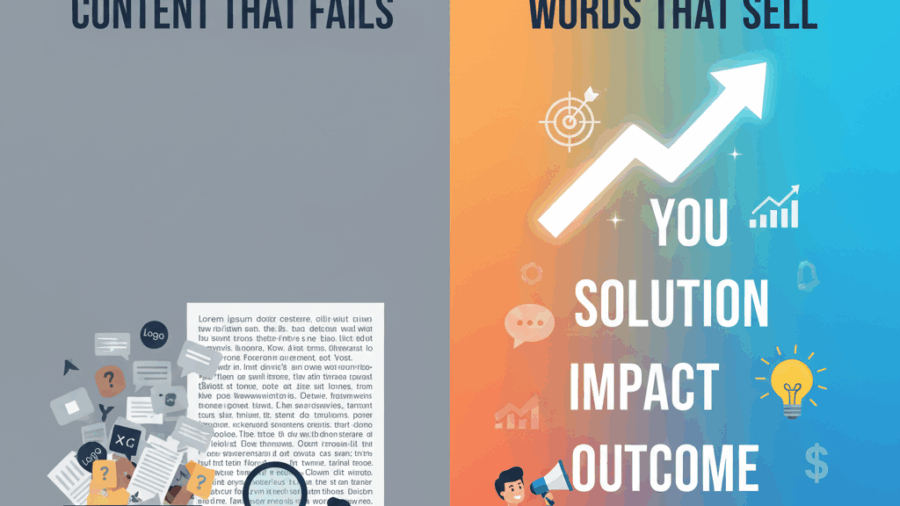
Why Most Business Content Fails (And How to Write Words That Sell)

Most business content fails. That’s not an opinion it’s the brutal truth. Scroll through LinkedIn, B2B blogs, or company websites, and 90% of what you’ll find is generic, bloated, and forgotten before the reader even clicks away.

Why? Because most brands write content for themselves, not for their audience. They hide behind jargon, brag about features, and churn out copy that no one remembers. If you’re here to win, not just “publish something,” then let’s rip this apart and rebuild it.

Here are 7 reasons business content fails and how to flip each mistake into content that actually sells.

1. Talking About Yourself Instead of the Reader

Copywriting mistake #1: Businesses love to write “we, we, we.” We are leaders. We are innovators. We are passionate. Guess what? Nobody cares. Your reader isn’t there to validate your company’s ego. They’re there to solve a problem. When your copy starts with you, you’ve already lost.

Better move: Flip the script. Start every piece of business content with “you.” Speak to the reader’s world, their frustrations, their goals. Example: Instead of “We provide cutting-edge SaaS tools,” say “You’re sick of clunky software that slows you down. Here’s a faster way to work.” That’s content that sells.

2. Features Don’t Sell Outcomes Do

This one kills even smart companies. They think listing features equals persuasion. It doesn’t. No one buys a “secure server.” They buy peace of mind that their business won’t crash at 2 a.m. No one buys “AI-driven analytics.” They buy the feeling of walking into a boardroom with answers nobody else has.

Better move: Anchor features to emotions and outcomes. Use the “so what?” test. Every time you write a feature, ask: So what? Why should they care? Keep going until you hit a benefit that makes your reader lean forward.

3. Content That’s Boring, Vanilla, and Forgettable

Here’s the dirty secret: most business content is so bland you could swap the logo and no one would notice. That’s why it fails.

Your audience is drowning in sameness — blog posts that recycle the same five tips, LinkedIn posts that sound like AI spit them out, case studies that could cure insomnia.

Better move: Take a stance. Inject personality. Use a metaphor, a story, even a bit of controversy. Example: Don’t say “consistency builds trust.” Say “ghosting your audience is the business equivalent of not showing up to a first date.” People remember that.

4. Ignoring the Power of Storytelling

Facts tell. Stories sell. That’s not marketing fluff it’s neuroscience. Our brains are wired to retain stories 22x more than facts alone (Stanford research). Yet most business content still reads like a corporate report: flat, soulless, instantly forgettable.

Better move: Wrap your message in story arcs. Share how a client went from struggling to thriving, or how your team nearly botched a launch but turned it around. People buy into transformation, not bullet points.

5. Writing for Everyone (Which Means You Write for No One)

Another fatal content mistake: trying to appeal to “everyone.” When you write for all, you resonate with none. Great copy is specific. It calls out a pain so sharply that the right reader feels exposed and the wrong one clicks away. That’s good. That’s how you filter for real buyers.

Better move: Define your audience ruthlessly. Write as if you’re talking to one person sitting across from you. If your copy feels risky because it excludes someone, that’s usually a sign you’re finally getting it right.

6. Copy That Lacks Clarity and Punch

If your content makes people work to understand it, you’ve lost. Jargon, buzzwords, and bloated sentences are the fastest way to kill trust. Your reader isn’t impressed by “leveraging synergistic solutions to optimize growth.” They’re annoyed. And when people are annoyed, they don’t buy.

Better move: Cut the fluff. Short sentences. Strong verbs. Words a 12-year-old could understand. Remember: clarity isn’t dumbing down; it’s respecting your reader’s time.

7. No Call to Action (AKA: You Left Money on the Table)

Here’s the ultimate facepalm: business content that ends with… nothing. No ask, no CTA, no next step. Just a limp fade-out. If you don’t tell people what to do next, they’ll do nothing. Period.

Better move: Every piece of content should end with a clear, direct CTA. It doesn’t always have to be “buy now.” It could be “download the guide,” “book a call,” or “follow for more.” The point is — never let your reader leave without knowing where to go.

Final Word: Why Most Business Content Fails

Most business content fails because it plays it safe. Safe is forgettable. Safe is invisible. If you want words that sell, you need to stop writing like a company brochure and start writing like a human who understands what’s at stake for the reader. Make it clear. Make it emotional. Make it impossible to ignore.

Because in business writing, bland doesn’t build brands. Bold does.